Skip to content
The Face Shape Detector
Face shape guide

Triangle face shape

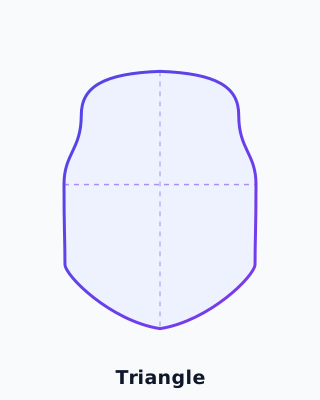
The jaw measures widest and the outline tapers upward to a shorter, narrower forehead.

  • Jaw measures 10 to 20 percent wider
  • Forehead forms the narrowest horizontal line
  • Cheekbones fall between jaw and forehead
  • Chin base runs broad rather than pointed
  • Face length holds near 1.25 to 1.45 times
Outline showing the proportions of a triangle face shape
  • 5

    Defining traits

  • 21

    Styling recommendations

  • 468

    Landmarks the detector maps

  • 7

    Face shapes to compare against

A triangle face (pear shape) inverts heart geometry. The jaw forms the widest horizontal measurement, usually exceeding the forehead by 10 to 20 percent, the cheekbones measure somewhere between the two, and the outline tapers upward rather than down.

Jaw character carries the shape. Triangle jaws run wide at the gonial angle and usually carry a broad chin base, whether the corner itself is sharp or softened. The mandible holds the structural weight, and it holds it low.

Above that, the forehead is short, narrow, or both, under a hairline that often sits low and rounded. Face length stays moderate, 1.25 to 1.45 times cheekbone width, which keeps the outline from reading as a long rectangle. Google's MediaPipe Face Mesh measures the same spans from 468 landmark points, and the ascending sequence from forehead to jaw is what names the shape.

Below you will find the widths that define it, a two-line comparison you can run at a mirror, the square, round and heart misreads, how hair, weight, age and camera height deepen the downward imbalance, and the styling logic that lifts width into the upper face.

A jaw wider than the forehead

Jaw width leads. It runs 10 to 20 percent past the forehead, and that single comparison names the classification.

Cheekbones sit in between and never peak. They measure closer to the middle of the range than to either extreme, which keeps this shape distinct from round and diamond.

The forehead closes the picture. Short, narrow, or both, often under a low rounded hairline, while total face length stays moderate against cheekbone width.

Horizontal lineTriangleHeart
ForeheadNarrowestWidest
CheekbonesIntermediateNear-widest
JawWidest by 10 to 20%Narrowest
ChinBroad basePointed
Direction of taperUpwardDownward

Comparing the top and bottom rows at a mirror takes one ruler.

Comparing the top and bottom lines

Comparison beats precise measurement as a first move. Pull the hair fully back, including anything falling forward, and stand square to the mirror at eye level. The forehead figure is diagnostic and cannot be assessed through hair.

Hold a ruler horizontally at the widest part of the forehead and note where the ends land, then move it to the widest part of the jaw. The lower line is visibly longer here, which reverses what most people expect to see.

Check the cheekbones next. They should measure between the other two spans without forming a peak. Cheekbones that are clearly the widest line put you in round or diamond instead.

Then look at the chin base rather than the tip. Triangle chins run wide where they meet the mandible, and a narrow base under a broad jaw indicates square or round.

Square is the first of those alternatives worth ruling out.

Triangle, square and the inverted heart

Square sits closest, since both carry width and often angle at the jaw. The forehead separates them. A square forehead matches the jaw within a few percent and produces vertical sides, while this shape runs a forehead clearly narrower and sides that splay outward as they descend.

Round overlaps when the jaw corner is soft. Round faces peak at mid-cheek and stay short relative to their width, while a triangle peaks at the jaw and runs moderately longer. A widest point sitting at or below the corner of the mouth means triangle.

Heart is the mirror image, and confusion nearly always comes from photographs. A camera below eye level enlarges the jaw and shrinks the forehead, manufacturing this shape, while a high camera does the reverse. Double-check any classification made from a casual snapshot.

Hair can produce the same illusions with no camera involved.

What exaggerates a bottom-heavy read

Hair hides the defining feature at either end. Volume at the temples and above the ears broadens the top enough that a triangle photographs as oval or square. Hair worn long, flat and tucked behind the ears exposes the full jaw width and steepens the taper. Low heavy bangs shorten an already short forehead and strengthen the bottom-weighted read.

Weight change concentrates in the lower face for many people, so gain reinforces the shape and loss softens it. Submental fullness under the chin extends the widest line further and makes the taper look steeper than the bone underneath. The forehead figure stays constant, so the ratio moves entirely from below.

Age strengthens the read. Jowl descent adds width just forward of the jaw corner, temporal hollowing narrows the top of the face, and masseter development from years of clenching broadens the lower half in men.

Photo angle is the decisive variable. Laptop webcams and phones held at chest height both enlarge lower-face width. Add a close wide-angle lens and the jaw is enlarged twice over. Shoot from three feet, camera at eye level, head untilted.

Building the top out to meet the jaw

Mass sits low on this outline, so the organizing principle is to build width and height above it while keeping the jaw uncluttered. The aim is to bring the top of the face out to meet the bottom, never to attempt shrinking the mandible itself.

Building above is the primary lever and has two parts. Width comes from volume placed at the temple and over the ear: textured layers starting at the cheekbone, side-swept bangs with lift, curls allowed to expand at the crown and sides. Height comes from root lift, which lengthens a short upper third and rebalances the vertical proportions at once.

Keeping the jaw clear is mostly a list of things to avoid. Blunt lines cut at jaw level, heavy one-length ends resting on the bone, and dense volume below the ear all pile mass onto the widest span. Ends that taper, sit above the jaw, or fall well past it to the collarbone dodge the collision.

Frames and facial hair follow the same reasoning. Weight in the upper half of a frame broadens a narrow forehead, while bottom-heavy or wide low-sitting styles repeat the imbalance.

An outline whose jaw outruns the forehead by a clear margin, tapering upward through intermediate cheekbones, is what the pear classification measures. The comparison table sets it against heart row by row. One ruler held at two heights shows the lower line longer, and the chin base confirms it. Square is separated by forehead width, round by where the widest point sits, heart by direction of taper. Hair, weight, age and camera height each exaggerate a bottom-heavy read, and a low lens does the most damage. Styling then builds width and height above while keeping mass off the jaw, and frames and beards follow the identical rule.

Check the numbers before you change anything. The face shape detector compares jaw and forehead spans across 468 landmark points in your browser, keeps every image on your device, and names the shape it finds.
Styling

What suits a triangle face

These follow from the proportions above. Each one either balances the widest point or softens the sharpest line.

01

Hair

Hair that works

Cuts and partings that either balance the widest point or soften the sharpest line.

  • Start textured layers at the cheekbone to build width across the forehead
  • Lift side-swept bangs at the root for height and upper width together
  • Wear a pixie with crown and temple volume, leaving the jaw uncluttered
  • Taper a collarbone-length cut so the ends land well below the jaw
  • Set loose waves high, concentrating volume above the ear rather than below
  • Cut ends above the jaw or well past it so mass misses the widest span
02

Eyewear

Frames that fit

Frame outlines chosen against the shape of the face rather than the shape of the lens.

  • Choose browline frames whose heavy top bar broadens a narrow forehead
  • Lift the eye with cat-eye frames and upswept outer corners
  • Pick frames with thicker upper rims above a light, thin lower edge
  • Size round frames to sit high on the face, above the cheekbone
  • Try semi-rimless frames rimmed on top only to hold weight upward
03

Makeup

Makeup placement

Where light and shadow sit so the proportions read the way you want them to.

  • Contour the jaw corner and under the mandible to narrow the lower face
  • Sweep blush high on the cheekbone toward the temple to lift the midface
  • Extend a defined brow arch outward to widen the forehead
  • Choose a mid-tone lip and skip dark shades that add weight low
  • Highlight the forehead, temples and brow bone to bring the top forward
04

Grooming

Facial hair

Beard outlines that lengthen a short face or square off a narrow one.

  • Taper short stubble closely along the jaw so it adds no bulk
  • Leave the cheekline natural and low instead of shaving it high and wide
  • Set the neckline just above the Adam's apple and keep it tight underneath
  • Wear a short goatee or Van Dyke to pull the eye toward the center
  • Keep sideburns narrow so no extra width lands beside a broad jaw

Compare

Other face shapes

Most faces sit between two of the seven. Reading the neighbors is how you find out which pair is yours.

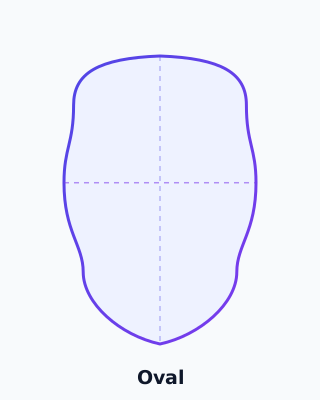
Length runs about one and a half times cheekbone width, tapering gently with no jaw corner.

  • Face length near 1.5 times cheekbone width
  • Forehead 5 to 10 percent wider than jaw
  • Cheekbones form the widest horizontal line
View hairstyles and glasses

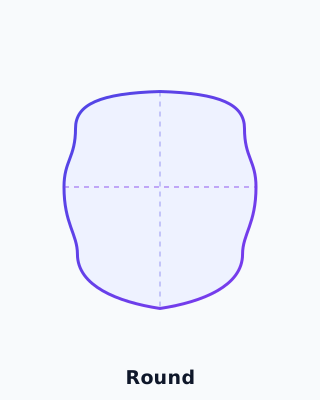
Length and cheekbone width run almost equal, widest across the cheeks, with no jaw corner.

  • Face length within 15 percent of cheekbone width
  • Cheeks form the widest point of the face
  • Forehead and jaw both measure narrower than cheeks
View hairstyles and glasses

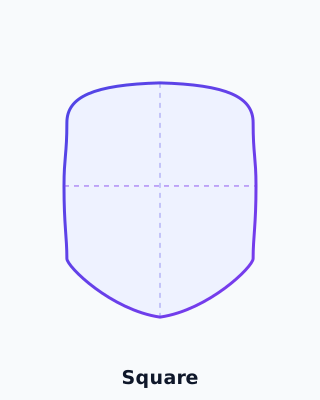
Forehead, cheekbones and jaw measure within about five percent above a sharply angled jaw.

  • Forehead, cheeks and jaw within about 5 percent
  • Corner at the jaw angle stays sharp
  • Face length only 1.0 to 1.25 times width
View hairstyles and glasses

Confirm you are triangle

Comparing yourself to a description is guesswork. Measuring takes ten seconds and gives you the actual ratios.