Skip to content
The Face Shape Detector
Face shape guide

Heart face shape

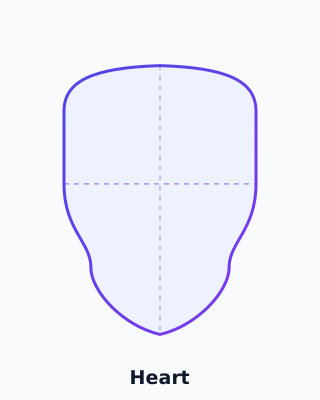
The forehead runs widest, the jaw narrowest, and the chin converges on a clear point.

  • Forehead forms the widest horizontal measurement
  • Jaw runs 15 to 25 percent narrower
  • Chin narrows to a pointed base
  • Widow's peak appears on many heart faces
  • Convergence below the cheekbone happens fast
Outline showing the proportions of a heart face shape
  • 5

    Defining traits

  • 21

    Styling recommendations

  • 468

    Landmarks the detector maps

  • 7

    Face shapes to compare against

A heart face is an outline that narrows steadily from top to bottom: the forehead is the widest horizontal measurement, the cheekbones sit just behind it, and the jaw comes in clearly narrowest, usually by 15 to 25 percent. That gradient is the entire classification.

Two features finish it. The chin closes on a point rather than a curve or a flat base, sometimes with a central cleft, and the narrowing below the cheekbone happens fast rather than gradually. A widow's peak, the V-shaped drop in the frontal hairline, appears on many heart faces and repeats the same inverted-triangle geometry higher up. It reinforces the read without being required for it.

Length stays moderate, between 1.3 and 1.5 times cheekbone width. Push much past that with the same taper and the face behaves like an oblong for styling purposes. Automated classifiers apply identical thresholds: Google's MediaPipe Face Mesh supplies 468 landmark points, and the forehead-to-jaw comparison is one subtraction.

Ahead you will find the defining gradient with a diamond comparison table, a two-line mirror check, the diamond, oval and triangle misreads, how bangs, weight, age and selfie height rewrite the result, and the redistribution logic behind every heart styling recommendation.

A face that narrows from the top down

Narrowing is the whole shape. Forehead widest, cheekbones close behind, jaw 15 to 25 percent narrower than the top line. Read the three spans in order and the gradient shows.

The chin finishes it with a point. A square chin has a broad flat base and an oval chin a rounded one, while this shape converges on something close to a vertex, narrow where it meets the bone.

Hairline shape often agrees. A widow's peak drops a V into the center of the frontal line and echoes the outline below it, though plenty of heart faces carry no peak at all.

MeasurementHeart faceDiamond face
Widest pointForeheadCheekbones
Forehead divided by jaw width1.15 to 1.301.0 to 1.10
Cheekbone vs foreheadEqual or slightly narrowerClearly wider
ChinPointedPointed
HairlineOften a widow's peakOften narrow and rounded

Two of those rows are what you check at the mirror.

Reading the forehead against the jaw

Forehead access decides whether this works at all. Pull the hair fully off the face, bangs included, and look straight ahead. The diagnostic feature sits under the hairline, so any coverage turns self-assessment into guesswork, and this shape is missed most often for that single reason.

Compare the top and bottom lines directly. Hold a ruler horizontally at the widest part of the forehead and note where the ends fall, then move it to the widest part of the jaw. The upper line is visibly longer here, no tape required.

Check the convergence rate second. Trace the outline from cheekbone to chin. That distance is short on a heart face and the narrowing is rapid, so the lower third occupies less visual area than the upper. A gradual taper finishing on a curve means oval.

Diamond is the harder call, and it needs one more measurement.

Heart or diamond: the temple measurement

Diamond sits closest and causes most errors, because both outlines finish at a pointed chin above a narrow jaw. The temples decide it. A heart face peaks at the forehead. A diamond peaks at the cheekbones with a distinctly narrow forehead above. Put your fingertips on your temples, then on your cheekbones, and whichever measures wider names the shape.

Oval tapers downward too, but by less and toward a different endpoint. An oval forehead exceeds its jaw by under 10 percent above a rounded chin, while this shape exceeds by 15 percent or more above a point.

Triangle is the exact inverse, and confusion appears mainly in photographs shot from below. A jaw wider than the forehead means triangle, and chin pointedness does not override that.

Hair and camera height manufacture two of those readings routinely.

What conceals the downward taper

Hair hides or invents this shape more than most. Full blunt bangs cover the widest measurement on the face and typically make a heart read oval or square depending on the jaw. Volume held high and wide at the temples deepens the taper until the outline reads almost triangular. Hair tucked behind the ears strips width from the lower third and sharpens the point.

Weight change acts mainly below the cheekbone, where this shape has the least tissue to start with. Loss deepens the taper and makes the chin look sharper than the bone is. Gain fills the sides of the lower face and softens a heart toward oval. The forehead figure barely moves, so the ratio changes entirely from underneath.

Age erodes the read. Mid-face volume descends and settles low and laterally where the outline is narrowest, while the temples hollow and shed a little upper width. Many heart faces at 25 measure closer to oval by 55.

Photo angle is decisive. The raised-arm selfie enlarges the forehead and shrinks the jaw, which is the heart signature exactly. Verify at eye level from three feet, chin neither lifted nor tucked, then apply the redistribution logic.

Moving visual weight lower

Weight sits high on this outline, so the organizing principle is redistribution: less apparent width at the forehead and temples, more alongside the mandible and chin, nothing that repeats the point at the bottom.

Adding low is the stronger of the two levers. A collarbone cut with movement at the ends, an outward-flicking bob, a beard grown fuller at the sides than at the chin, all of it counters the taper directly. Hair pulled tight to the ears does the opposite, and so does a narrow goatee that concentrates mass on the chin alone.

Reducing high works through softness rather than coverage. Side-swept bangs cut on a diagonal break the horizontal span of a broad forehead without deleting the face's vertical proportion, whereas heavy blunt bangs cropped straight across advertise its full width.

Frames obey the same rule. Choose visual weight at the bottom of the lens: rimless or light-rimmed uppers, bottom-heavy shapes, gently rounded lenses. Heavy browlines and wide decorated temple arms broaden the third that already dominates.

An outline that runs widest at the forehead, narrowest at the jaw, and finishes on a point is what this classification measures. The comparison table sets its gradient against diamond. A ruler held at two heights shows the top line longer, and the convergence rate below the cheekbone confirms the rest. Diamond is settled at the temples, oval by the size of the taper, triangle by which end is wider. Bangs, weight, age and selfie height each rewrite the result. Styling then redistributes: width down, softness up, no second point at the bottom.

Measure it properly first. The face shape detector compares forehead, cheekbone and jaw spans across 468 landmark points inside your browser, stores no photo anywhere, and returns the gradient with the name.
Styling

What suits a heart face

These follow from the proportions above. Each one either balances the widest point or softens the sharpest line.

01

Hair

Hair that works

Cuts and partings that either balance the widest point or soften the sharpest line.

  • Cut a collarbone lob with movement at the ends to widen the jaw line
  • Flick a chin-length bob outward to fill space alongside the pointed chin
  • Sweep bangs diagonally across the forehead to break a broad upper span
  • Start layers at the jaw rather than the cheekbone, keeping mass low
  • Part curtain bangs off center to shorten the visual span of the temples
  • Move volume off the temples into the mid-lengths with a low side part
02

Eyewear

Frames that fit

Frame outlines chosen against the shape of the face rather than the shape of the lens.

  • Choose rimless frames, which add no weight to an already dominant forehead
  • Pick bottom-heavy frames whose rim thickens below the lens to pull the eye down
  • Soften the chin with round or oval frames that repeat a curve above it
  • Size light wire aviators so the frame never exceeds forehead width
  • Wear thin cat-eye frames with slim temple arms instead of wide decorated ones
03

Makeup

Makeup placement

Where light and shadow sit so the proportions read the way you want them to.

  • Contour the outer forehead and temples to narrow the top of the face
  • Drop blush low on the apples and blend outward toward the ear
  • Keep softly rounded brows short at the tail so forehead width stays contained
  • Overdraw the lower lip slightly to add visual weight beneath the mouth
  • Highlight the chin and under-eye area rather than across the forehead
04

Grooming

Facial hair

Beard outlines that lengthen a short face or square off a narrow one.

  • Grow a full beard wider at the sides than the chin to fill the jaw
  • Square the bottom edge of a short boxed beard to blunt the pointed chin
  • Set a high full cheekline so the beard broadens the lower face
  • Keep the neckline one finger above the Adam's apple to hold bulk under the jaw
  • Widen a chinstrap style beard along the mandible instead of a narrow goatee

Compare

Other face shapes

Most faces sit between two of the seven. Reading the neighbors is how you find out which pair is yours.

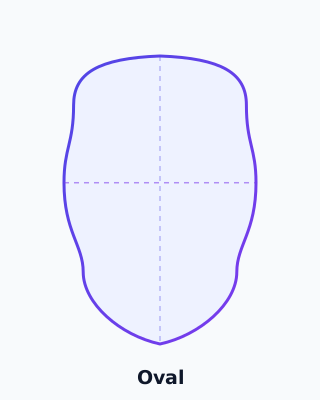
Length runs about one and a half times cheekbone width, tapering gently with no jaw corner.

  • Face length near 1.5 times cheekbone width
  • Forehead 5 to 10 percent wider than jaw
  • Cheekbones form the widest horizontal line
View hairstyles and glasses

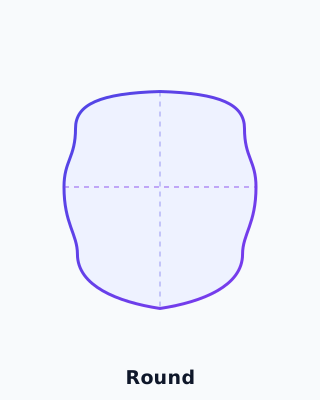
Length and cheekbone width run almost equal, widest across the cheeks, with no jaw corner.

  • Face length within 15 percent of cheekbone width
  • Cheeks form the widest point of the face
  • Forehead and jaw both measure narrower than cheeks
View hairstyles and glasses

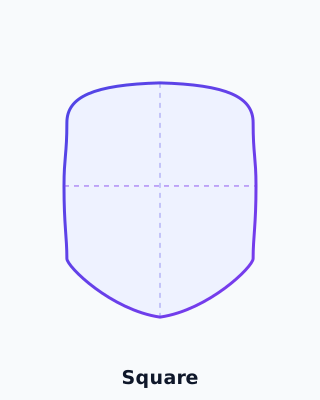
Forehead, cheekbones and jaw measure within about five percent above a sharply angled jaw.

  • Forehead, cheeks and jaw within about 5 percent
  • Corner at the jaw angle stays sharp
  • Face length only 1.0 to 1.25 times width
View hairstyles and glasses

Confirm you are heart

Comparing yourself to a description is guesswork. Measuring takes ten seconds and gives you the actual ratios.