Skip to content
The Face Shape Detector
Face shape guide

Diamond face shape

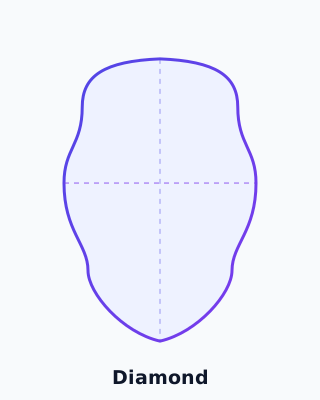
Cheekbones sit clearly widest, pinched by a narrow forehead above and a pointed jaw below.

  • Cheekbones measure 10 to 15 percent wider
  • Forehead stays narrow with close-set temples
  • Jaw narrows to a point without a corner
  • Face length runs 1.4 to 1.55 times width
  • Hollow shows beneath the zygomatic arch
Outline showing the proportions of a diamond face shape
  • 5

    Defining traits

  • 21

    Styling recommendations

  • 468

    Landmarks the detector maps

  • 7

    Face shapes to compare against

A diamond face is an outline pinched at both ends: the cheekbones form the widest horizontal line, typically 10 to 15 percent past the two spans either side of them, and the face narrows above and below. It is the least common of the seven classifications.

The forehead is what separates it from every other tapering shape. The frontal hairline is narrow and often rounded, the temples sit close in, and the difference between temple and cheekbone registers immediately under the fingertips. Beneath the cheekbone the outline closes again to a small pointed chin with little or no mandibular corner.

Length runs moderately long, commonly 1.4 to 1.55 times cheekbone width. Combine that with the double taper and you get the elongated rhomboid the name describes. Google's MediaPipe Face Mesh reads the same three spans from 468 landmark points, and the low-high-low pattern between them is the signature no other shape produces.

What follows: the widths that define the shape, a lighting-dependent mirror method, the heart, oval and oblong misreads, how hair, weight, age and lens choice flatten or exaggerate the cheekbone peak, and why the styling logic runs opposite to heart advice.

Pinched at both ends

Cheekbones lead by a clear margin, 10 to 15 percent over both neighboring spans, and everything else on this outline follows from that peak.

Above them the face closes in. A narrow frontal hairline and close-set temples produce the upper pinch, and this measurement is what tells diamond from every other tapering shape.

Below them it closes again. The jaw is narrow with little bony angle, the chin small and pointed, and the whole lower third occupies less width than the middle.

Horizontal lineRelative width on a diamondNote
ForeheadNarrowest or joint-narrowestKey differentiator from heart
TemplesNarrow, close-setOften the flattest area
CheekbonesWidest by 10 to 15%High and prominent
JawNarrow, no cornerLittle bony angle
ChinPointed, small baseShared with heart

Reading those five rows at a mirror takes the right light more than the right tape.

Side light and the three-number test

Light does half the work here. Tie the hair completely back and face the mirror with the source slightly above and to one side, because cheekbone prominence is the defining feature and flat frontal light erases the shadow that shows it.

Work top to bottom. Forehead at its widest, cheekbones at their widest, jaw at its widest. A diamond returns a low-high-low sequence with the peak in the middle, while nearly every other shape returns a descending run, an ascending run, or three near-equal numbers.

Then look for the hollow. Tissue recedes between the zygomatic arch and the mandible on this shape, producing a visible plane change. Prominent cheekbones sitting above a full continuous lower face point to oval or round instead.

Heart is the reading that most often takes its place.

Diamond against heart, oval and oblong

Heart accounts for nearly every misclassification, and one measurement separates them. Both taper to a pointed chin over a narrow jaw. A heart forehead is the widest part of the face, while a diamond forehead ranks among the narrowest with the cheekbones dominating. Compare forehead to cheekbone rather than forehead to jaw and the ambiguity closes.

Oval claims the second batch, usually because this shape is uncommon and rarely offered as a choice. Oval needs a forehead slightly wider than the jaw and only slightly narrower than the cheekbone. A forehead that is clearly the narrowest of the three rules it out.

Oblong overlaps on length alone. Oblong runs as a column with no dominant span. An outline that holds one width from top to bottom is oblong, and one that swells at the middle is diamond.

All three readings respond to hair, tissue volume and lens distance.

What flattens the cheekbone peak

Hair carries unusual influence here, because a narrow forehead is easy to hide and easy to fake. Temple volume adds apparent upper width and shifts a diamond toward oval or heart. Hair pulled back with the ears exposed strips width from beside the cheekbones and makes the peak look extreme. Blunt bangs covering the forehead delete the diagnostic measurement outright, which is why people who wear them rarely classify themselves correctly.

Weight change has outsized effect. The submalar hollow under the cheekbone fills early with gain and empties early with loss. A modest gain softens the double taper until the face measures oval. A modest loss deepens it until the bone looks skeletal.

Age sharpens the middle and blurs the bottom. Buccal and malar fat decline from the thirties, deepening the hollow, while jowl descent adds low lateral width this shape does not naturally carry.

Photo angle distorts severely. A close wide-angle phone lens inflates whatever sits nearest it, which here is the peak itself. Shooting from below flattens the shadow and broadens the jaw toward square. Use three feet, eye level and soft directional light before you act on the styling logic.

Widening the top and bottom

One dominant point with a deficit either side of it defines the styling problem. The aim is to broaden the upper and lower thirds so the mid-face peak becomes one strong feature inside a balanced outline rather than the only thing the eye catches.

Top width is the stronger lever. Side-swept bangs, textured bangs with lift, and volume built at the temple all broaden the narrow upper third. This runs directly opposite to heart advice, which is the practical reason the two shapes have to be told apart before anyone picks up scissors.

Jaw width is the second lever. Chin-length and collarbone-length cuts with movement at the ends, waves that expand below the cheekbone, and facial hair grown fuller along the mandible all fill the lower deficit. Styles pulled tight at ear level accentuate the peak instead.

Exposure is the third consideration. Sweeping everything back removes every softening element at once and leaves the peak fully exposed, so keeping some softness at the temple usually reads better.

An outline widest at the cheekbones and pinched at both the forehead and the jaw is what the rarest classification measures. Five table rows set the relative widths. Side lighting plus a top-to-bottom read returns the low-high-low sequence, and the hollow under the arch confirms it. Heart is separated at the forehead, oval by the same measurement, oblong by whether the outline is a column or a rhombus. Hair, weight, age and lens distance each flatten or exaggerate the peak. Styling then adds width above and below it, the reverse of what a heart face needs.

Get the classification right before the haircut. The face shape detector measures forehead, cheekbone and jaw spans from 468 landmark points in your browser, uploads no photo, and reports which line is widest.
Styling

What suits a diamond face

These follow from the proportions above. Each one either balances the widest point or softens the sharpest line.

01

Hair

Hair that works

Cuts and partings that either balance the widest point or soften the sharpest line.

  • Sweep bangs to one side with lift to broaden the narrow forehead
  • Wear textured blunt bangs wide across the forehead to add upper width
  • Flare a chin-length bob outward to fill the space beside a narrow jaw
  • Begin layers below the cheekbone so volume lands at the jaw, not the peak
  • Part deeply at one side and build volume at the temple rather than the crown
  • Leave softness at the temple instead of slicking everything back off the face
02

Eyewear

Frames that fit

Frame outlines chosen against the shape of the face rather than the shape of the lens.

  • Pick cat-eye frames whose upswept corners widen a narrow forehead
  • Add browline frames with a strong top bar to build breadth above the cheekbone
  • Soften a prominent zygomatic arch with oval frames and rounded edges
  • Size rimless frames wider than the cheekbone so the midface is not pinched
  • Try round frames on slim metal temple arms to keep the cheekbone uncrowded
03

Makeup

Makeup placement

Where light and shadow sit so the proportions read the way you want them to.

  • Contour lightly along the outer cheekbone and never inside the hollow beneath
  • Place blush on the apples and blend forward toward the nose, not the temple
  • Extend a rounded brow arch slightly outward to widen the forehead
  • Overdraw the lower lip line a little to balance the pointed chin
  • Highlight the center forehead, chin and brow bone, keeping it off the cheekbone
04

Grooming

Facial hair

Beard outlines that lengthen a short face or square off a narrow one.

  • Grow a full beard wider at the jaw to fill the narrow lower face
  • Square a short boxed beard at the bottom to blunt a pointed chin
  • Set the cheekline high and full to add width under the cheekbone
  • Curve the neckline just above the Adam's apple to hold mass under the jaw
  • Run light stubble across jaw and chin instead of a chin only goatee

Compare

Other face shapes

Most faces sit between two of the seven. Reading the neighbors is how you find out which pair is yours.

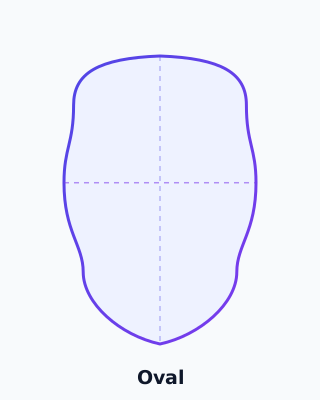
Length runs about one and a half times cheekbone width, tapering gently with no jaw corner.

  • Face length near 1.5 times cheekbone width
  • Forehead 5 to 10 percent wider than jaw
  • Cheekbones form the widest horizontal line
View hairstyles and glasses

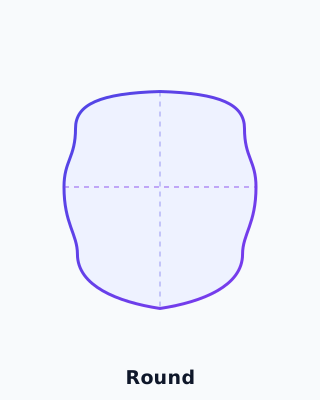
Length and cheekbone width run almost equal, widest across the cheeks, with no jaw corner.

  • Face length within 15 percent of cheekbone width
  • Cheeks form the widest point of the face
  • Forehead and jaw both measure narrower than cheeks
View hairstyles and glasses

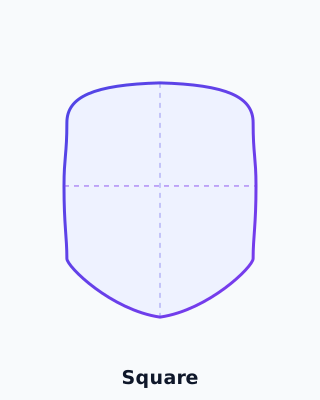
Forehead, cheekbones and jaw measure within about five percent above a sharply angled jaw.

  • Forehead, cheeks and jaw within about 5 percent
  • Corner at the jaw angle stays sharp
  • Face length only 1.0 to 1.25 times width
View hairstyles and glasses

Confirm you are diamond

Comparing yourself to a description is guesswork. Measuring takes ten seconds and gives you the actual ratios.