Real proportional measurements
Read the numbers behind the label: length-to-width ratio, three facial widths and your gonial angle in degrees, rather than a category name on its own.
Upload a photo and 468 facial landmarks are mapped on your device in seconds, so nothing is ever uploaded. You get your shape, the four measurements behind it, and the hairstyles, glasses, makeup and grooming that suit it.
7
Face shapes detected
468
Facial landmarks mapped
14
Free analysis tools
0
Photos ever uploaded
Two ways to start
Both run the same analysis on your own device. Pick whichever is easier right now.
Choose an existing photo from your device.
Take a new photo with your device camera.
3 simple steps
From photo to personalized style recommendations in under a minute. Here is exactly what happens when you use the tool.
Face the lens at eye level, hair pulled back, expression neutral. Your image stays in the browser while 468 MediaPipe landmarks map across hairline, temples, cheekbones, jaw corners and chin.
Forehead width is read at the brow ridge, cheekbone width across the zygomatic arches, jaw width between the gonial angles, and total length from hairline midpoint to chin base.
Your length-to-width ratio and the taper between the three widths narrow the field, then the gonial angle separates square from round. Styling guidance arrives with the result.
What you get
Every result ships with the numbers behind it, so you can check the reasoning yourself.
Read the numbers behind the label: length-to-width ratio, three facial widths and your gonial angle in degrees, rather than a category name on its own.
Detection runs inside your browser through Google MediaPipe. No image reaches a server, gets stored anywhere, or is shared with anyone at any stage.
Oval, round, square, oblong, heart, diamond and triangle each carry explicit numeric thresholds, so borderline outlines get flagged instead of forced into a box.
Every result carries haircut, fringe, eyewear and neckline guidance built on the counterbalance principle stylists and opticians have worked from for decades.
Manual method
Take four measurements with a soft tape measure or a piece of string, then compare the numbers. No guessing required.
Measure across the widest point of your forehead, roughly halfway between your hairline and your eyebrows.
Widest on heart and square
Measure from the outer corner of one eye to the outer corner of the other, straight across the top of your cheeks.
Widest on oval and diamond
Measure from the tip of your chin to the jaw angle below your ear, then double that number for the full jaw width.
Widest on triangle and square
Measure from the center of your hairline straight down to the tip of your chin, keeping the tape vertical.
Longest on oval and oblong
Length greater than width points to oval or oblong. Length close to width points to round or square. Cheekbones widest points to oval or diamond. Forehead widest points to heart. Jaw widest points to triangle.
Face shape guide
Every face falls into one of seven shapes, each with proportions that guide the best hairstyle, glasses and grooming choices.
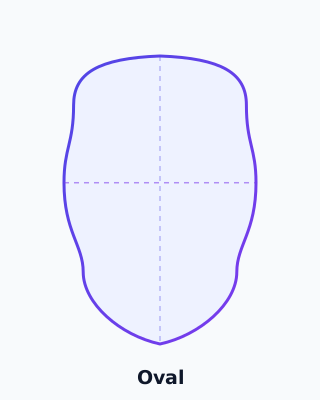
Length runs about one and a half times cheekbone width, tapering gently with no jaw corner.
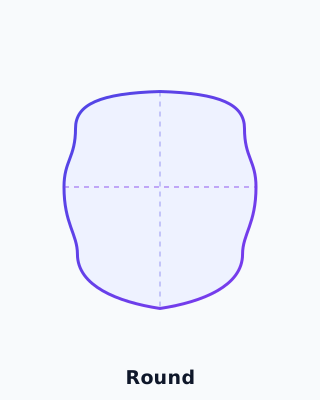
Length and cheekbone width run almost equal, widest across the cheeks, with no jaw corner.
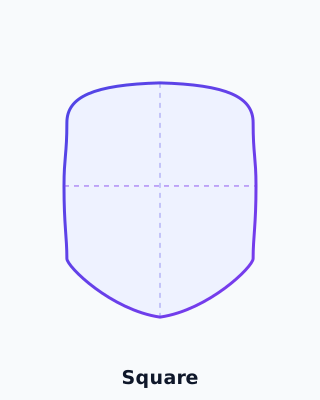
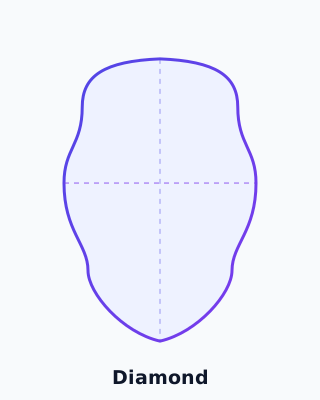
Forehead, cheekbones and jaw measure within about five percent above a sharply angled jaw.
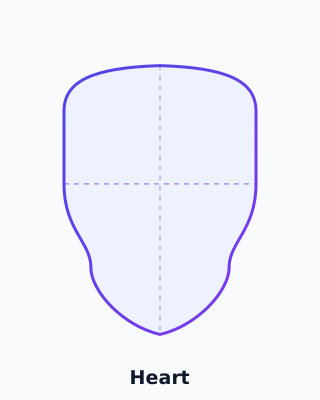
The forehead runs widest, the jaw narrowest, and the chin converges on a clear point.
Cheekbones sit clearly widest, pinched by a narrow forehead above and a pointed jaw below.
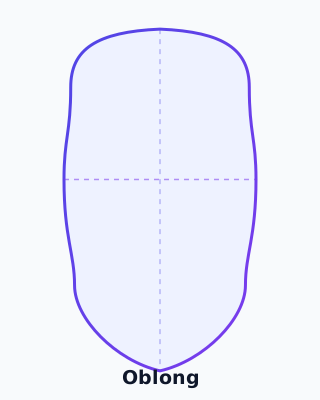
Length clearly outruns width, the sides run near-parallel, and the middle third measures long.
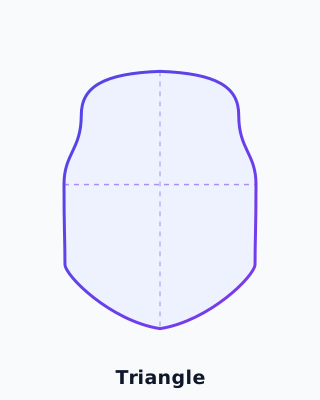
The jaw measures widest and the outline tapers upward to a shorter, narrower forehead.
Why this one
Free, private and specific. Here is what you can expect before you upload anything.
Your photo is processed inside your browser. There is no upload endpoint on this site, so nothing reaches a server.
No queue and no waiting. The model runs on your own device the moment you choose a photo.
No account, no email, no card. Every tool on the site is free with nothing held back behind a wall.
Phone, tablet or desktop, in any modern browser. Nothing to install and nothing to update.
Free AI tools
All tools run entirely in your browser. Your photo never leaves your device, and no sign-up is required.
Measure canthal tilt, lid crease and eye spacing from a photo to place you among the ten eye shape descriptors.
Try it freeMeasure your nasal index, bridge profile and tip projection from a photo to place you among the eight nose types.
Try it freeMeasure vermilion height, mouth width and cupid's bow definition from a photo to name your dominant lip trait.
Try it freeMirror your facial landmarks about a computed midline and score how closely the left and right halves correspond.
Try it freeCompare your facial proportions against phi, roughly 1.618, across seven classical ratios and read the full per-ratio breakdown.
Try it freeAnswer twelve questions about your skin, hair and eyes to find which of the 12 seasonal palettes matches your coloring.
Try it freeSample your forehead and cheek color from a photo to estimate a Fitzpatrick type and a warm, cool, neutral or olive undertone.
Try it freeEnter your bust, waist and hip measurements to see which of the five body shapes your proportions match.
Try it freeFind your somatotype from frame measurements and questions: ectomorph, mesomorph, endomorph or a hybrid of two.
Try it freeAnswer questions on bone, flesh and vertical line to find which of David Kibbe's 13 image identities fits you.
Try it freeA for-fun geometric score showing how closely your facial proportions sit to statistical averages and classical canons.
Try it freeHow landmark similarity matching compares faces, and why this matcher reports as unavailable until a trained model ships.
Try it freeWhat visual age estimation reads in a face, and why this estimator reports as unavailable until a trained model ships.
Try it freeThe complete guide
Face shape classification (facial morphology typing) sorts the outline of a human head into one of seven named categories using four measurements. The seven are oval, round, square, heart, diamond, oblong and triangle. The scheme grew out of portrait painting, then out of twentieth-century hairdressing and optical dispensing manuals, where stylists needed fast vocabulary for balancing a client's proportions.
Four numbers do the work. Three are horizontal chords, taken across the brow ridge, the zygomatic arches and the gonial angles. The fourth is a vertical drop from hairline to chin base. Divide that drop by the widest chord and you have the length-to-width ratio: readings near 1.0 are short and compact, readings past 1.5 are elongated. A fifth value, the interior angle at the gonial corner, settles the cases the ratio leaves tied.
Google MediaPipe Face Mesh supplies the geometry. Its 468-landmark topology fixes sub-pixel positions for the hairline, temples, cheekbones, jaw corners and chin, and the whole computation happens inside your browser tab. No image is uploaded, received or stored.
Below you'll find what the seven categories are for, the measurements and taper profile built on them, a side-by-side comparison of every shape, how stylists convert a label into haircut, fringe, eyewear and neckline choices, the photo conditions that shift a reading, and the limits of measuring a three-dimensional skull from a flat picture.
Categories are a starting point for styling, not a description of who you are. Two people given the same label can look nothing alike, because the label compresses four numbers and discards skin, expression, coloring, feature size and profile depth.
They also sit on a continuum, and plenty of faces land within a few hundredths of a boundary. What makes the reading repeatable is the set of measurements underneath it.
Measurements come as one vertical and three horizontal, each taken from named skeletal landmarks rather than eyeballed.
Those four also produce the taper profile, which compares the three widths and reports whether the outline narrows upward, narrows downward, or runs parallel. Taper plus the ratio resolves five categories on its own.
The remaining pair needs the gonial angle. Below roughly 120 degrees the jaw reads square and defined. Above roughly 135 degrees it reads soft and rounded. That angle is the only thing separating a square outline from a round one when their proportions are near identical, which is why both sit together in the comparison below.
| Shape | Length to width | Width relationship | Jawline signature |
|---|---|---|---|
| Oval | 1.45 to 1.6 | Cheekbones widest, forehead a little broader than jaw | Gently curved, no hard corner |
| Round | 0.95 to 1.15 | All three widths close to equal | Soft, obtuse gonial corner |
| Square | 0.95 to 1.2 | All three widths close to equal | Sharp, near right-angle corner |
| Oblong (rectangle) | Above 1.5 | Widths near equal, outline long | Squared, softened by the extra height |
| Heart | 1.3 to 1.5 | Forehead clearly widest, jaw narrowest | Narrow, pointed chin |
| Diamond | 1.4 to 1.6 | Cheekbones dominant, forehead and jaw both narrow | Angular, tapered to a point |
| Triangle (pear) | 1.2 to 1.45 | Jaw widest, forehead narrowest | Broad and heavy at the base |
Oval is the reference the other six get described against: moderately long, widest at the cheek, curving gradually from temple to chin. Oblong is a square stretched vertically. Heart and triangle mirror each other, one tapering down and one tapering up. Diamond turns up least often, since it needs both the forehead and the mandible narrower than a pronounced cheekbone line. Each label drags styling conventions along with it.
Styling conventions run on one principle: counterbalance. Add apparent width where the outline is narrow, add height where it's short, soften where the line is hard.
None of it survives a bad photograph, which is where most disputed results begin.
Photographs decide the numbers, so five capture conditions matter more than the algorithm does, listed here in descending order of impact.
Keep your head level and square to the lens. Ten degrees of yaw compresses one side and shifts every horizontal reading, and projection sets the ceiling on accuracy.
Accuracy is capped by the medium. A photograph is a flat projection of a three-dimensional skull, so depth gets inferred rather than measured. How far a cheekbone comes forward, how deep a chin sits: neither is in the picture, and two people with different profiles can share one frontal outline.
Borderline readings are common and are not errors. A ratio of 1.47 sits on the oval-to-heart boundary, and a small change in lighting or pose tips it either way. Two labels from two photos means you carry features of both.
Reported reliably: your proportions, which region is broadest, which is narrowest, and how the thresholds relate to those figures. Not reported at all: health, ancestry, character or attractiveness. The numbers are objective. The aesthetic conclusions drawn from them are conventions, and any convention you dislike can be ignored.
Seven categories, four measurements, one browser tab. The system compresses a head outline into three horizontal chords, one vertical drop, a taper profile and a gonial angle, then names the closest of oval, round, square, heart, diamond, oblong or triangle. The table shows how each differs from its neighbors, the styling section converts a label into haircut, fringe and eyewear choices, and the capture checklist protects the numbers from hair, expression, camera height and lens distortion. The limits stay on the page: flat projection, soft boundaries, nothing medical. Upload a level frontal shot to the face shape detector and read the ratios, not just the name at the top.
From the blog
Every article starts from a measurement rather than an opinion.
A complete hair guide organized by face shape, from the geometry that governs every cut to named styles for all seven shapes. Includes fringe matching, texture adjustments and exactly what to tell your stylist.
Frames work by contrast, and frame width should match the widest part of your face. This guide covers the right styles for all seven face shapes, plus color and fit.
Four readings and two ratios are all it takes to name your face shape without guesswork. This guide covers the protocol, the thresholds, and a worked example.
Questions
Everything people ask about the detector, how it works, accuracy and privacy. The full list is on the FAQ page.
Seven: oval, round, square, oblong, heart, diamond and triangle. Oval sits widest at the cheek with a gradual curve to the chin. Round and square share their proportions and split on jaw angle. Oblong is a square stretched vertically. Heart and triangle mirror each other, one tapering down and one tapering up, while diamond needs a narrow forehead and jaw under dominant cheekbones.
No. The face mesh is computed locally by Google MediaPipe running inside your browser tab. Your image never travels to our servers, is never written to a database, and clears from memory when you close or reload the page. Nothing is retained after your session ends, and no account is needed to use the tool.
A photo wins on repeatability. Landmark detection places the same anatomical points every time, while a tape slips against soft tissue and depends on how hard you press. A tape wins on depth, since it can follow a curve that a flat image cannot see. For proportional ratios, which is what classification needs, the photo method is the more consistent of the two.
No. Your photograph never leaves your device. Every face tool on The Face Shape Detector runs its analysis inside your own browser using Google MediaPipe, a landmark model the browser downloads once and then executes locally. There is no photo upload endpoint on our servers, so no address exists for an image to be sent to, even by mistake. You can confirm it yourself in about a minute: open your browser's developer tools, switch to the Network tab, and run an analysis. The model file downloads. No image goes anywhere.
Nothing from the tools. Photo analysis and quiz answers alike stay on your device, so color analysis, body shape, body type and Kibbe results are never written anywhere we can read. What The Face Shape Detector does collect is narrow and ordinary: contact form submissions, saved to a database so we can reply; standard server access logs holding IP address, timestamp and browser type; Google Analytics measurement data; and advertising data collected by Google AdSense. The public site has no account system and no login, so no profile of you exists to build.
No, the camera path works the same way. Grant camera permission and your browser hands the video stream to the page, which renders it into a local canvas frame by frame for the model to read. Frames are analyzed and discarded immediately. Nothing is recorded, and nothing is transmitted. Most browsers scope that permission per site and per session, and you can revoke it at any moment from the padlock or camera icon in the address bar. Prefer not to grant it? Use the file picker instead, for an identical result.
The 468 landmarks are numbered points that the MediaPipe Face Mesh model places on a detected face: along the jawline, around each eye, across the brows, down the nose bridge, around the lips and over the cheeks. Each carries an x, a y and an approximate z coordinate. Once the mesh is fitted, geometry becomes arithmetic. Face length is the distance between two points, jaw width the distance between two others, and a face shape classification is a set of ratios between those distances compared against defined ranges.
Because the geometry the model measured genuinely changed between the two shots. A head tilt of a few degrees alters width to height ratios. Side lighting darkens one edge of the jaw and moves the outline. A smile widens the lower face. A close range selfie lens enlarges central features relative to the perimeter. Hair across the forehead hides a measurement the model needs. When two photographs disagree, take a third: square to the camera, neutral expression, even front light, hair back, camera at arm's length or further.
No. There is no app, no plugin, no extension and no account. Everything runs in a standard web browser on a page you have already loaded. The only thing that downloads is the MediaPipe model file, which your browser fetches automatically and caches like any other web asset. Camera access is optional too: you need to grant it only if you choose the camera option rather than picking a file from your device. Nothing is charged for any of this, at any point.
A good photo faces the camera square on, with your eyes level and a neutral, relaxed expression. Use even light from the front. A window during daylight works well, while overhead spotlights and strong side light cast shadows the model may read as an edge. Pull hair away from your forehead and jaw. Hold the camera at arm's length or further to avoid lens distortion. Aim for at least 600 pixels across your face, unfiltered and uncropped. Those five conditions account for most of the variation between two results.
The length-to-width ratio divides total face length, hairline midpoint to chin base, by the widest of the three horizontal measurements. Readings near 1.0 describe a short compact outline. Readings past 1.5 describe an elongated one. It is the first value any classification system computes, and it narrows seven categories down to two or three before any other measurement is applied.
Yes, gradually. Facial fat distribution shifts with age and body weight, which mainly moves apparent cheek and jaw width. Bone structure changes far more slowly, with some remodeling of the gonial angle across decades. A result that changes within weeks is almost always caused by weight, swelling or photo conditions rather than by skeletal change.
Four causes account for almost every disagreement. Hair crossing the temples narrows the detected forehead. A smile widens the cheekbone line. Holding the phone below eye level enlarges the jaw. And a wide-angle front lens exaggerates whatever sits nearest the sensor. Retake the shot at eye level, an arm's length away, hair back, under even frontal light.
Processing happens on the processor inside the device you are holding. When you pick a photo, the browser reads the file into memory, draws it to an in page canvas, and hands those pixels to the MediaPipe model already loaded in the tab. The model returns 468 coordinate points, and The Face Shape Detector's code computes ratios from them. All of it stays inside the browser's own sandbox. No step in the chain sends a network request carrying your image, and closing the tab discards everything.
No, and it would be impossible. Training needs collected images, and none ever reaches us. The landmark model behind the face tools is Google's pre trained MediaPipe Face Mesh, which arrives at your browser already trained, stays unmodified by anything you do, and sends nothing back. No image analyzed here is stored, logged, sampled, queued for review or added to a dataset, ours or anyone else's. That follows from the architecture rather than from a promise somebody has to police.
Broadly yes, with one caveat about the machine rather than the site. Because no image is uploaded, nothing about your face persists on our side. What can persist locally is browser state: a theme preference in local storage, quiz progress in session storage, and analytics or advertising cookies. And if you picked a photo from the machine's own file system, that file is still sitting there. Use a private or incognito window, close the tab when you finish, and delete any file you copied onto the device.
Landmark placement on a clear, front facing, evenly lit photograph is reliable to within a few pixels, and the arithmetic that follows is exact. The uncertainty sits elsewhere. Face shape categories have no agreed scientific boundary, so where one shape ends and the next begins is a judgment encoded in our thresholds rather than a fact about faces. Expect a dependable answer when your proportions sit clearly inside one category, and genuine uncertainty when they sit near a boundary. That is why confidence percentages get published alongside every result.
Because a single answer would misrepresent the certainty. Most faces are not textbook examples of one category; they sit between two. A result of 44 percent oval and 38 percent heart is not the tool failing to decide. It is an accurate description of a face with oval proportions and a heart shaped hairline. Reporting only "oval" would throw away the more useful half of the finding. Read the top two figures together, and where they sit close, treat both sets of styling guidance as relevant to you.
Partly, and not by design. Your first visit needs a connection to load the page and the model file. Once your browser has cached that model, an analysis may still run while you are offline, because the computation itself needs no network at all. We do not guarantee it. Cache behavior varies between browsers, and a cached model can be evicted at any time. Treat offline operation as an occasional side effect rather than a feature you can plan around.
Yes, with a caveat for each. Glasses bias the eye landmarks, so remove them for the eye shape tool and keep them on when you are testing frame styles. A beard changes the visible jaw outline, so a face shape result describes the bearded outline rather than the bone beneath it, which is useful for choosing a haircut and less useful for reading your structure. A headscarf covering the hairline hides the forehead measurement, lowering confidence in face shape but not in eye, nose or lip analysis.
One photo, a few seconds, and no sign-up. You get your shape, the numbers behind it, and what to do next.
Your photo never leaves your device.